The Gurus of Time
Two original voices on mechanical repetition, lived time, identity and persuasion. Philosophical language is offered in addition to, never instead of, mechanical evidence.
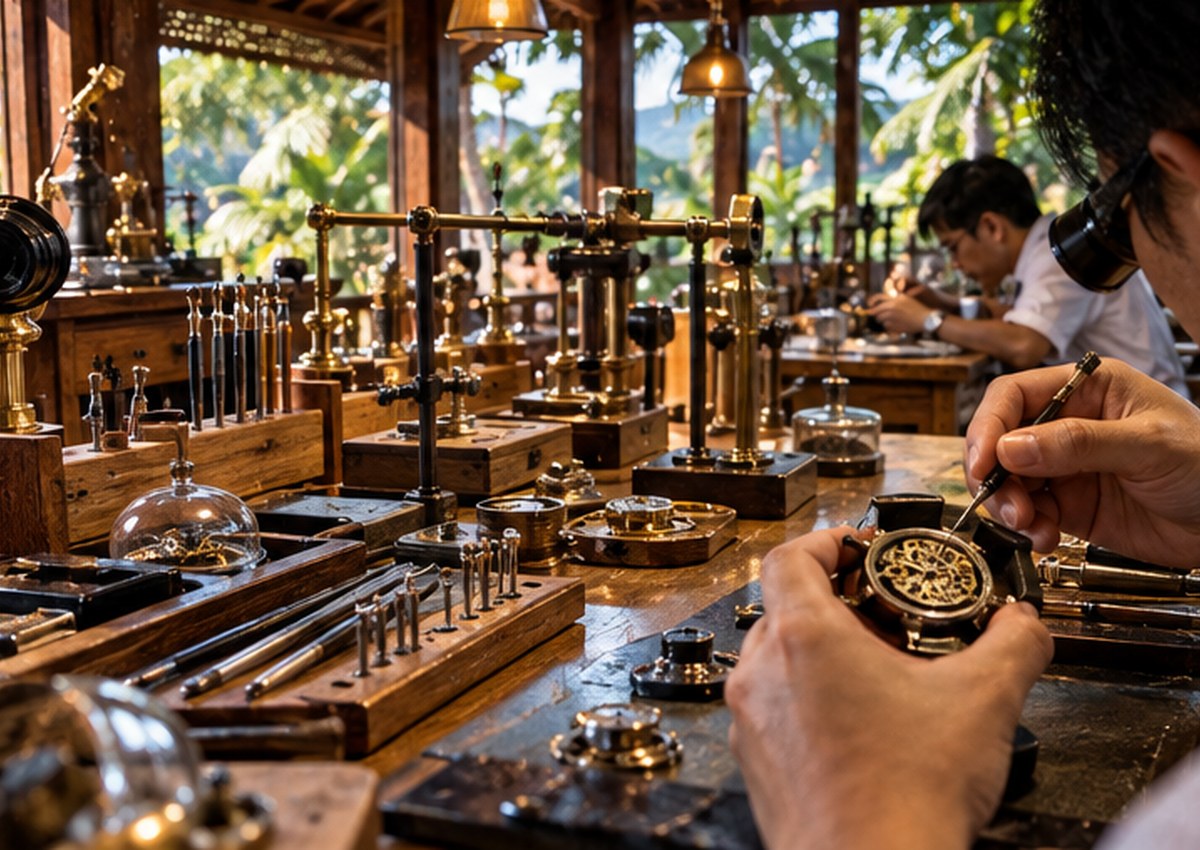
Lecture / Professor Theo Mercer
The Clock Repeats; the World Does Not
Among the many beautiful misconceptions about mechanical watches is the thought that they are machines for repetition. They do repeat, of course. But repetition is not their only work. Every tick advances the hands to a place they have not occupied since yesterday, and yesterday is no longer available for comparison.
An escapement behaves less like a dictator than a border official. Energy arrives from the mainspring. The mechanism permits a little of it through, then makes it wait for the balance to return. There is nothing mystical about this. It is a brilliant practical arrangement whose elegance is sufficient without supernatural claims.
In tropical places, timepieces reveal the environmental world: moisture challenges cases and gaskets, heat changes material behavior and magnetic fields can alter rate. A competent watchmaker listens carefully to symptoms, then uses instruments. A poet may call this a dialogue with nature. A technician writes down the amplitude.
Patterns are invitations to look again. I have spent afternoons studying tide marks on boats and mornings studying beat errors on a timing machine. They do not share a cause. They share a demand for patient observation. Confusing resemblance with proof makes a bad scientist and a dangerous watch repairer.
The lesson of the field is modest and liberating. The wheel comes around again. The light on the bench is different. So are you. Neither the sea nor the watch is required to explain the whole of existence. Both can give you excellent work to do.
End of lecture · Professor Theo Mercer
Years ago, a visitor asked whether a more accurate watch might make him a more successful person. I asked what he intended to do with the seconds he gained. He was disappointed to learn that an escapement offers no savings account. A watch reports time honestly; living it remains our own responsibility. It is possible to miss an appointment. I suspect it is also possible to be present at one's own life without counting every moment.
My first field notebook from India contains descriptions of a watch, a road, a storm and a conversation I cannot now remember. I can service the watch, reproduce the itinerary and identify the storm by date. The conversation is irretrievable. The clock repeated; the day did not. Bring both a loupe and an open mind, but when repairing a movement, trust the loupe.
Lecture / Dr. Celeste Maren
The Watch You Think You Are

A watch can tell you the hour. It can also tell your acquaintances what sort of story you hope they will believe about you. The second function is not a fault in the movement, although many collectors wish there were an adjustment screw for it.
Consider the inherited watch. It may be inexpensive, inaccurate and badly scratched. Yet it can be the most important object in a room because it served as witness to someone else’s habits. The scratch becomes a map of affection. The person who winds it becomes a temporary custodian of memory.
Now consider the opposite purchase: a flawless, expensive watch intended to announce the owner’s competence. The purchase may be delightful, but it cannot do that work on its own. A watch will not make its wearer generous, capable or at peace. It is a marvelous machine, not a substitute for character.
The most reliable test of a story is the difference between what the object promises and what it actually does. Does it run? Has it been serviced? Can its provenance be documented? These questions are not unromantic. They allow romance to survive contact with reality.
Keep the watch if it makes you attentive, grateful or curious. Sell it if someone else will enjoy it more. Repair it when the work is sound. And if it stops, begin with the battery or balance before diagnosing the condition of your soul.
End of lecture · Dr. Celeste Maren
Some students ask how to tell whether a generous offer is truly generous. I tell them to read the terms, then ask why the person offering it is smiling. Dr. Waite objects to that answer, although she has never explained which half she dislikes.
Questions for the faculty?
Our local Ask a Guru desk dispenses a small selection of the faculty’s observations. It does not contact a real person or an AI service.